Read episode transcript
Automated Whisper transcript. Names and wording may contain errors.
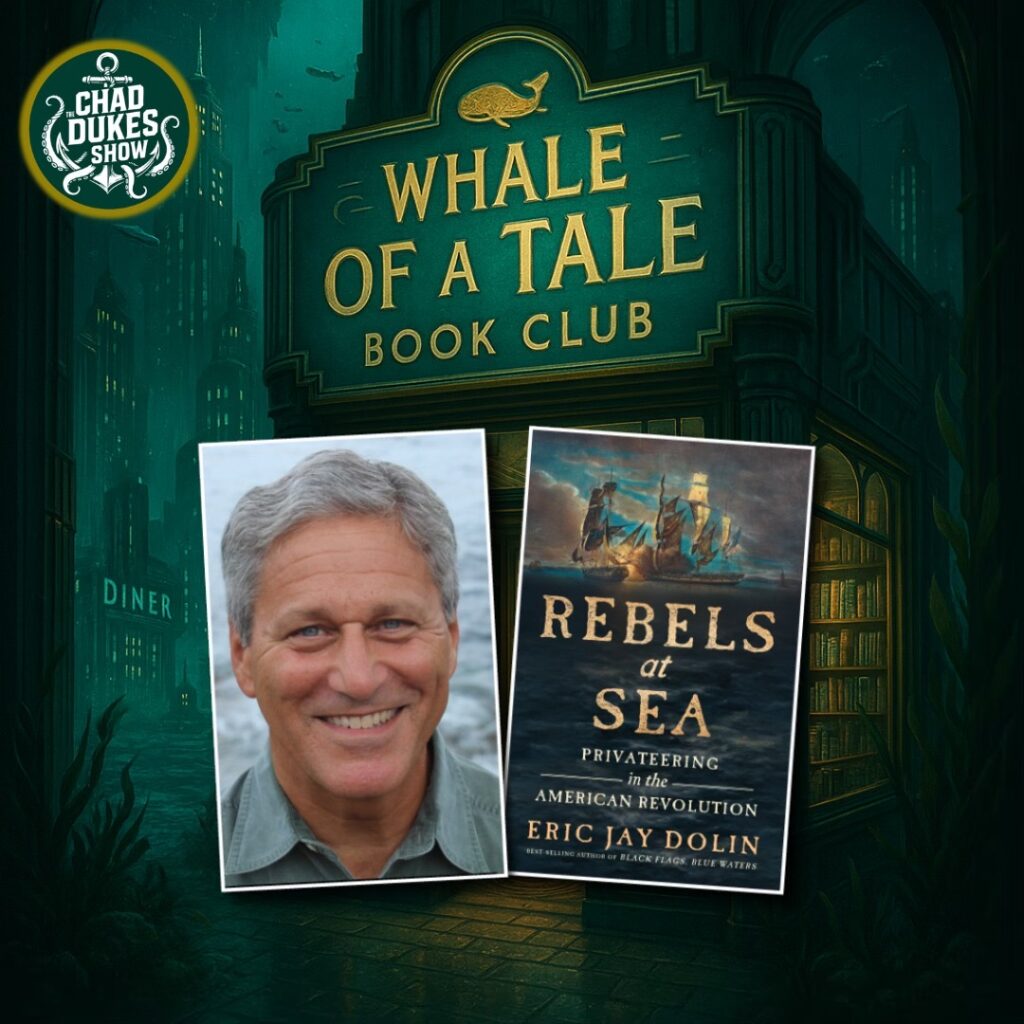
For daily episodes of the Chad Dukes Show, head on over to ChadDukesShow.com and slide a few shekels across the barrel head. Take it from me, Sweet Daddy James. Listening to the Chad Dukes Show is more fun than a naked tour of the Back River Wastewater Treatment Plant. It's the Chad Dukes Show. Very excited for some of you. You may be aware. Started a book club recently. A man in his mid-40s starting a book club. That's just what you do. We're very excited because we are a nautical maritime book club. This book jumped off the shelf. I recently was touring Mount Vernon for the first time since I was a child and went into the bookstore and saw a copy of Rebels at Sea by Eric J. Dolan. Lucky enough to find a signed copy. I think they still have some there if you'd like to pick one up. It's absolutely fascinating. As someone that's consumed discussion of piracy my entire life, privateering, honestly, other than some sea shanties, it never really came up. And this book was incredibly insightful. And we're lucky enough to have him now on the Monk's Barbecue Hotline. Eric, thank you so much for the time today, buddy. How are you? Fine. Thanks for having me. I appreciate it. How was the signing at Mount Vernon? I assume you signed those books there. Yes, but in two different ways. I went down to Mount Vernon. I can't remember what year it was. It was in the past two or three years. And I gave a talk out Mount Vernon on Rebels at Sea. And while I was there, I signed a bunch of books. And in the bookstore, they've done well. So since then, I think that it's been three separate times that the manager sends me a list of, not a list, a bunch of book plates to sign, usually 50 at a time. So I get an envelope of 50 book plates from the Mount Vernon gift shop from George Washington's Mount Vernon. I signed them all and I send them back. So obviously, the book is still selling well. That's great. It is. And that's the one I have because I'm looking at the plate right now. So this must have been in your living room at some point, which is. Yes. I don't even know how much you remember about touring that place, but I hadn't been since I was a kid. And I didn't realize how much fishing was an operation there and like the scope of their fishing operation when to provide for the plantation. And it's right there on the water. And you have to walk down an incredibly steep slope to get to the wharf. I don't know that there was. I found that very enlightening being. I didn't expect that at Mount Vernon when you think, hey, I'm going to learn about the first president of this country, colonial times. I don't know. For some reason, that aspect of what they were doing there never crossed my mind. Yeah. Well, we were a maritime nation from the start. Certainly in the first hundred years, so much of the country was within a couple of miles of the coast. And George Washington, like everybody else, depended on the coast for getting products that were brought by ships and for sustenance and fishing. A lot of people say that he wasn't really a maritime president. He had only been on a ship for a long trip. Once when he went down to the Caribbean, his brother was suffering from tuberculosis, if I'm remembering correctly. But that's really not true. He knew a lot about the ocean and a lot about rivers and was fascinated by trade. And certainly the plantation benefited by coastal routes. And the people on the plantation benefited from being able to fish in the Potomac and also get the fish that came out of the Atlantic Ocean, which were brought up the river. So, yeah, that's one of the reasons I got interested in maritime history. I live in Marblehead, Mass., which is on the ocean. When I was a kid, I wanted to be Jacques Cousteau when I grew up. Of course. That didn't pan out. But I did pursue marine biology for a number of years. And then I slowly drifted into writing. And since I've always lived within a few miles of the ocean, I just fell in love with stories of the sea. And more importantly, the way in which the ocean and the products from the ocean and the opportunity for people to travel across the ocean, how that opened up and, in fact, generated American history. The evolution of the country is intricately intertwined with the maritime world. And when I say maritime, I include rivers and lakes as well, although some people say maritime. That's just saltwater. But it sort of encompasses all of it. All right. Listen, I have too much to ask you, and you're going to need to let me know if this goes overboard because you just sparked it. First of all, you're right about George Washington because I just recently read it in your book, Rebels at Sea. That story is in there. And it's very interesting. All right. Let's start with this. The contradictory nature of privateering is really fascinating to me. And that's the one thing I really wanted to make sure I asked you about. This is a difficult topic because clearly one of the things you point out in your book, for people that haven't read it, is how essential this was and how important it was for this burgeoning nation. We would not, without these men doing this, we probably wouldn't have gained our independence. And there's that component of it. But also, for lack of a better term, it seems like a trope, saying it, legal piracy is wild. And so you're talking about setting up a structure where, okay, now we're sending out the letters of Mark. But if you attack these boats, well, then we're going to have a problem and we're going to split the booty up with the government and then we're going to pay the boys out. But then if you get caught, you're not getting treated. You're not giving any type of accommodations. You're getting treated like a pirate by the enemy of this country and you're going to get locked under a deck somewhere and probably starve to death. This is an incredibly complicated thing that was happening. It happened for many years. What is it like trying to write a book and tackle it when there's so many different vantage points? Well, the first thing was, when I started looking at this topic, it really sprang out of my book on, quote unquote, real true pirates of late 1600s and the early 1700s. I wrote a book called Black Flags and Blue Waters, which has all your famous people like Blackbeard and Sam Bellamy and Captain Kidd, who was really a pretty minor pirate. But that book, when I was getting book talks on that book, a lot of people would bring up privateering. And I mentioned privateering in the book, but it wasn't a major topic. And that got me curious. So I started reading more about privateering. And as you know, because you know a little bit of my background, my undergraduate master's and PhD is in biology and public policy. I am not a trained historian, even though I am an historian because I tell stories about history. So I knew a lot about the American Revolution. However, when I started seeing references to privateering during the American Revolution, I said, it was like eye opening. I said, what? And I started reading more. And I found this whole area of history embedded in the American Revolution, which very few of the books that I had read on the American Revolution, even maritime books, talked about. So the deeper I dove into the subject, the more fascinating it became to me, certainly enough to write a book. But coming at it from all these different angles, essentially, it's a way that I write any kind of book. Since I don't have a steep, deep background in this topic, every book is sort of like getting a master's degree. But I try to extend my search as widely as possible. So the first thing that I do is look at any contemporary documents that talk about the thing that I'm writing on. And fortunately, there were a lot of newspaper articles at the time. There were books that came out shortly after the American Revolution. There were a few privateers, especially privateers who also served in the army, who wrote about their experiences that provided a lot of insight into what this activity was. And then there were tons of letters written by many of our, quote unquote, founding fathers, you know, Jefferson, Adams, Washington, Hancock. They all wrote about privateering to each other and to the Continental Congress. And then, of course, there's a Continental Congress, which to our great benefit as historians and also just as Americans. They kept pretty detailed records of what they said during the Congress. And a lot of the discussion focused on privateering. So over time, when I pulled from all these different sources, what it did for me is it gave me a very complex vision of what privateering was. And then it was my job to try to put it down in a coherent manner so that people could understand how this multifaceted, intriguing endeavor during the American Revolution contributed to us coming out on the winning side. It was fun. I like researching. You know, I like writing, too. I think I like researching a little bit better than the writing. But I enjoy both. But the thing that's great about researching is you get surprised, especially me, who didn't have a deep background in privateering. Every week or two, I was finding some document or some piece of information that was, wow, you know, that's wild. You know, George Washington invested in a privateer. At the same time, he hated privateers, at least his public pronouncements. You know, all this contradictory. So it's all human nature as, you know, through the lens of war. And it was just fascinating. The other thing, and this has nothing to do, well, I guess it has something to do with privateering. The thing that this book really hammered home to me, and I had inklings of this before because I had some of my other books talked about the American Revolution, is how what George Washington said was so true, it was almost a miracle that we won. There were so many points during the American Revolution at which things could have gone sideways. Or one general, either a British or American, could have made a single different decision to go left instead of right, to retreat instead of fight. You know, and it would have changed the outcome of the entire war, most likely. And unfortunately, as a historian, you can't go back and have a control group and say, let's play out different scenarios. It's not like you're playing a game of risk or something. But it's just amazing to me. Because a lot of people, when they look at history books, they read them as if that's the way it had to happen. And the one thing that history teaches me, at least, is that that's absolutely not true. Things often can go in a very different direction. And it's not inevitable. What happens was not inevitable. And certainly for the people during the American Revolution, there are many points during it where they thought they were on the cusp of losing. And there were many times in which the English thought they were on the cusp of routing the Americans. But somebody made the wrong decision in hindsight, depending on whose side you're on. Well, it's a great point. And the part about it that, to me, seems almost insurmountable, and I think you do a great job, especially early in the book, of trying to put into perspective the might of the British Navy, like what England was able to have. And they were established. And they dominated. And their vessels were there. Like they're operating out of Boston. And then it's like, okay, we're thinking about having a revolution. We've got a couple of these colonies that have navies, but most of them don't. What are we going to do? The fact that we had to bootstrap it, and then you tell these stories about guys in longboats, like rowing out from the harbor and jumping on top of boats. And then, okay, that's our boat now. Now we're sailing this, excuse me, ship. And we sail it back in. And now we're going to outfit that. And that's going to become our. That part of it is what's so nuts to me. Head start doesn't even feel like the right word. I know we're here and they were there and having to come over here. But still, we bested them in many ways at what their greatest strength was. And that just seems, again, almost insurmountable. Right. No, it's fascinating. I mean, we were part of England. We were the mother country. They were already here, maybe not in as great force as they came to be later in the revolution. But, yeah, it was shocking that the colonists took on this battle. And it was equally shocking to the British that these group of colonies were rebelling, given how they felt about them. But that's another fascinating thing about history. Britain at this time was, you know, it was very arrogant. It was a very arrogant country because they were so powerful. And what often happens is powerful countries or entities become so imbued with their power that they fail to see potential weaknesses or alternative scenarios in which maybe they're not going to come out on top. And one of the turning points in the American Revolution, I think, was the very beginning. When you read what the British, the Parliament in particular, and the king was saying about the Americans, despite the fact that Americans had the highest per capita level, quality, what's the word, you know, amount of money. They were among the richest people in the world at that time on a per capita basis. And they were well, many of them were well educated, especially the quote unquote elite. They were a mini England. Yet if you read what the British were saying about the colonists, they viewed them all as like, you know, they didn't use this word, sort of rubes or hicks or uneducated or just, you know, second class citizens. That's certainly how they treated them. So if they hadn't been so arrogant at the beginning and they hadn't thought that they were just fighting a quote unquote rabble in arms and they had realized that the militias in the colonies were fairly powerful and these men knew how to fight, in part because Americans had contributed mightily to England's success during the Seven Years' War, the French and Indian War, which is just about 10, 15 years earlier. So it wasn't as if Americans didn't have experience fighting. George Washington had, you know, cut his teeth in earlier conflicts and as had many of the future privateers and people in the Continental Navy and in the Army. So it's almost as if England, by virtue of some of their earlier wars, had been a training ground for Americans to give them some information or skills that they could then turn around and use during the American Revolution. And I think that just England really, if they could have gone, if they could go back and instead of viewing the Americans in such a condescending light, they had decided this is potentially a very formidable enemy. Let's hit them with everything we've got right away. The war would have been over. I'm just convinced that that would have happened. It's like when an expert boxer gets caught, you know, they get hit in the chin in a certain way. They go down. I don't know if you watch UFC, but Matt Serra beat George St. Pierre. He's one of the greatest fighters of all time and knocked him out. It was a great moment. But then George St. Pierre came back and he was the incredibly superior fighter and dismantled him. And, you know, I guess the War of 1812, maybe we got a taste of that. But, you know, they never got that second shot at us in that meaningful way. EricJDolan.com. You've got to go to the website. All of his books are up there. There's so many fascinating topics. We're talking about rebels at sea, privateering in the American Revolution. Of course, that was the book, the very first inaugural book for the Whale of a Tale Maritime Book Club, which many of you have been chastising me for. But, ha, sounds pretty cool now, doesn't it? All right. The outfitting of the boat. I love this. There's a movie there where they're taking whaling vessels and they're taking these guns and they're putting, okay, we have to have 20 guns here. We need to be fast because the opening volley back and forth at the beginning where you have a much smaller ship attacking a much larger ship. I just love that aspect of it. It seems almost steampunkish. But is there any way to, I guess we have drawings, but just seeing that in person must have been unbelievable, the different variety of ship. And then you double that with, okay, we've captured this British ship. Now we're bringing it back and we're attacked and they recapture the ship and then they capture our ship. I just, keeping everything straight, especially when you're doing your research, must have been difficult. But that aspect of it, the way that we decided, okay, now we're all in. Let's get these rich guys' boats and let's get some guns on them. Can you talk a little bit about what that process must have been like? Yeah. It would have been fascinating if we could go back and go to some of these major ports or even minor ports where they were outfitting privateers. It just must have been a beehive of activity. They're cutting holes in the bulwarks. Bulwarks, they're mounting cannons, some of which they've gotten from British ships they've captured. Others were created in some of the few foundries that we had in the colonies. Some of the cannons were in great shape. Some of them exploded when they tested them out and killed men on board the ship before they got out of port. And then there was the victualling or the getting all the food on board the privateer, even though they didn't go out for years at a time, like a whaling ship, they didn't go out for weeks or months at a time. So you had to get a lot of food on board. You had to get the people on board. So you invited a lot of them to a local pub. And you got them drunk, perhaps. They signed on to the articles. I love that. The privateer. It was just it's a massive operation, but it's happening 100,000 times over because each merchant who owned a ship, they were experienced in outfitting their ships to go on merchant voyages to Europe or the Caribbean or elsewhere. But they just had to take the same skills they had gathered with when being a merchant and just apply them to being a privateer because the outfitting of the ship, other than adding armaments, was sort of relatively well known. And then getting the people on board, many of the people on board were among the same people who were working for them when they were merchant carriers and not privateers. And it just it just must have been wild to be in Salem or Boston or Philadelphia and walk the streets. The must have been incredibly busy. A lot of interesting noises coming from the wharf and they're refitting or outfitting these ships. And then they're saying goodbye to all their friends and family. Who knows when or if they're going to come back. And as the war wore on, these privateers, the one that signed on, they had a lot of guts. I mean, anybody had guts at this time to go out in the open ocean. They didn't have the kind of navigational equipment we have now and assurances of survival. But as the war wore on, the Americans were fully aware that when you were captured as a privateer, you were treated horrifically by the British and you would undoubtedly end up in prison. And maybe one of the prison Hulk ships in New York Harbor, which was a virtual death sentence. So it's just it is truly amazing how many people signed up to be privateers, how many lost their lives. I mean, more than it's probably more than 10,000 privateers alone lost their lives during the war. And there may have been as many as 30 or 40,000 of them during the course of the war. So it was just a shame to me that their story had been sort of forgotten or displaced by the equally heroic stories of battles of famous generals and on land. But part of the reason for that is because a lot of the generals and the people in the Continental Navy and the people in the Continental Army were among the more wealthy, educated individuals. And a lot of them that survived wrote accounts of their time during the American Revolution and their heroics. So those stories became the staples that we read about, whereas most privateers men were from the lowest rung of society. Even some of the captains, they weren't necessarily well educated. A lot of them died. And those that survived, very, very few people who worked on a privateering vessel sat down and wrote their memoirs. So we don't have as much, whereas we have tons of writing by all the founding fathers that we get book after book after book on. You know, there have been who knows how many. There's been probably more than 10,000 books on George Washington alone and Ben Franklin. But these privateers were just average people and they sort of remained faceless and nameless for a long time. The most impressive thing you got to either put your eyes on personally or lay your hands on when you're doing research. What was the coolest thing that you got to come across as you were looking into this? Because as you said, the materials are somewhat unconventional for this topic. Well, some of the objects, I really liked looking at letters of Mark. I saw a couple in person and I saw a couple of cannons and swivel guns and other implements that had been on privateering vessels. But really, what I find most interesting and difficult at times is to read some of the journals, but also some of the newspapers of the time. The reason I found it so fascinating is not only would there be a short story about a privateer action, maybe in Martinique or Dunkirk or something like that. But because all of these early American newspapers have been digitized, I do a lot of my work in my office where I'm talking to you from on my computer. So all of a sudden, I have in front of me an entire four-page edition of the Boston Postboy or something like that or the Hartford Current. And not only do I read the article, but I sort of scan the rest of the newspaper. And it's just fascinating. You have ads for all these things that people were using back then, which we don't even know what they are anymore. And notices of people, you know, very meaningful, disturbing notices, even in northern newspapers. You know, this slave escaped. Here's what he looks like. Please return him to the owner. And everything from that to little notices about, you know, so-and-so got divorced and has been verbally abusing their former husband or wife. And, you know, don't take their credit anymore or something like that. Very personal things. Or I lost a cow. Here's the description of the cow. If anybody finds this cow, come back. It was just neat. It was sort of like getting a snapshot into what life was like at that time, which you get to some extent by looking at a newspaper or something. And now we're getting more and more online. But, you know, looking at some kind of news source. But we don't really have in newspapers the classified advertising that we used to have when I was young. And certainly back in the day in the American Revolution, half of the paper was basically classified ads or little stories that you describe as, you know, snake oil salesmen trying to sell you a cure for everything. And it was just fascinating to look at that stuff. And also going, I live in Marblehead. Even though the ports here, Marblehead wasn't big into privateering. But Salem was next door. Boston. You know, Philadelphia, New York. I've been to all these ports. And I've walked around. And it's hard to really envision anything from that era. But every once in a while, just going into a house that was built during the American Revolution or around that time that still might be near the port. We're just looking at some of the old wharfs like Derby Wharf in Salem, which is still there and is the same place that Elias Haskett Derby, a very important privateering ship owner, sent out many of his ships. If you just stand there, especially after you've read so much about this, you can almost imagine what it must have been like. And just the thought of trying to put yourself in that position. It's very difficult. We live a pretty comfortable life now. But could you imagine if you're breaking away from another country? I mean, it happens all over the world. There are people that have broken away from countries in the last century, for sure. Or maybe they had similar feelings, but it is such a leap into the unknown. And then add on top of that, if you're a privateer and say you're a green hand and you came off of a farm in hopes of making some quick money and maybe helping your country to be realize its ambitions. All of a sudden, you're on a ship. You have no knowledge of what maritime life is like. And you're probably throwing up the first couple of weeks out of port. And then you're actively going out and searching for British ships to attack. And not all of them were easy marks. Even the merchant ships. British merchant ships were often outfitted with numerous cannons. They didn't have huge crews. But they could be, an East Indian man could be quite an alarming prospect for usually a smaller privateer to attack. And it's just amazing. I just thought it was an amazing story. There's no part of me that would want to be a privateer. But the way you described it, I'd love to go to a privateering recruitment party. Those sounded like a great time. And if you haven't read the book, I guess they would put out these ads and they would throw these big blowouts. And they'd have a bunch of booze. And then they'd promise you booze on the ship. And then you'd have this exciting. It sounded like a great time just trying to be wooed onto one of these vessels. Yeah. Oh, absolutely. Well, it's sort of human. It's preying on human psychology, which still works today. People always overestimate the upside of an adventure or an investment or whatever you think. And they discount the downside. And that's what people were doing to some extent. And it's sort of like, you know, part of it was speculation. It was almost like gambling. You know, if you go into a casino, you're going to lose if you stay there long enough. But most people who go into a casino, I think, when they walk in that door, they have visions in their head of hitting the jackpot. And a lot of privateers, when they went on these ships, they probably thought much more about the potential upside of capturing a few heavily cargoed British merchant ships that could be sold for a lot of money and helping out their family than they were focusing on spending the rest of their life in a prison or a prison ship. Now, what does it take, like, if someone's going to commission you for a topic, is that something you would accept? Like, what is the process like there? No, I've never been commissioned for a – I mean, my – you mean how much can I be bought for? Yeah. How do you – like, what is your level of bribery? What are we talking about here? No, all the books. I mean, I've written 16 books. And all the books have come from my head pretty much. But there have been one or two books that my publisher at the time suggested, but that – they don't – they're not giving me money to do it. They say, is this something you'd be interested in? And then I have to go and research it. And if I'm interested, I write a proposal. And if they're interested in my proposal, they give me an advance. So that's been the process for all my books. I try to find a topic that I'm interested in. And right now, I just handed in a book about three weeks ago, four weeks ago, and I'm starting to think about my next book topic. And I'm not sure what direction I'm going in. But to answer your question more directly, there's one parallel. When I was in grad school, when I was in a master's program, there was a Know Your Government series that I wrote a short book. It was 50 books about all government agencies. And I was doing environmental policy at the time. So I wanted to write the book about EPA, but that had been taken. So they gave me the Fish and Wildlife Service, which actually gave me insights because I love nature and wildlife and the history. So I wrote that short book, and I got paid a set amount, a very small amount, to write that book. So I guess it's like other books where you get an advance. But if somebody came to me – Yes. If somebody came to me and they said, I've got this book I want you to write. Yes, I have a book I want you to write. Yes, that's what I'm doing right now. I'm sure there's a number at which. But it has to be a pretty high number. And I'd have to be interested in the book. Maybe the problem is that I'm old or older. I'm in my 60s. I know where my next meal is coming from. I have a house. My kids are out of the house. I'm not as desperate and as hungry as I was 30 or 40 years ago. So it would probably take quite a bit to get me to write a book. Well, let me – can I give you the topic and see if it – I mean, you're probably familiar with it, I would assume. What's that? Well, I know you wrote a book about lighthouses, and you've written a book about piracy. So the Outer Banks of North Carolina, like how familiar are you with that area? Well, I'm familiar in terms of the history, especially from those two books. And I've been to Ocracoke and Kitty Hawk and Cape Hatteras, but only – I think I was only – I was only there once. So I'm not personally that familiar with it. Have you been to the graveyard of the Atlantic Museum in Hatteras? I have not, but I have seen it online. I've reached out to them a couple of times to see if they wanted to have me down there to give a talk, but they never responded. Well, they're foolish. They're foolish then. They recently redid it, and I've been going down there my whole life, and I was very familiar with, like, the land pirates in the Outer Banks. Like, that's why the name Nags Head came about is they'd wrap the lantern around the Nags Head. People would think it was a lighthouse. The boats would maroon themselves, and you'd swim out, and you got yourself a ship. I didn't – I wasn't aware of the absolute brutality in World War II. There was, like, a six-month span where there was U-boats just camped down at Hatteras, and they sunk something like 70-plus vessels. And every time I think of the shipwrecks of the Outer Banks, I think of what you're talking about, like piracies, you know, back from revolutionary times. I don't think of World War II, and I'm wrong. And there's just – they destroyed us for months and months and months. And at this place, they have the U-boats, and then they have pictures of the craft that they destroyed, and they have relics from it. And I'm like, this is an incredible story. And I've searched online, and no disrespect to the gentleman that wrote the book, but I saw a rather meager offering writing about it. And as I was – I couldn't help but stop myself a couple of times reading your book, reading Rebels at Sea, and saying, wow, Eric would do a really good job writing about this topic. And that's why I felt incumbent upon myself to bring it up. No, I think it's a great topic. I've actually thought about something along the same lines, and in particular writing something about World War II. But I think I'd have to – I'll do some searching because I don't think that – I think there's been some stuff written about that. But then again, I've been in this business long enough. Not that – well, I've only been a full-time writer since 2007, but I talk to a lot of writers. And I've got to tell you, I am always amazed because my theory is when I come up with a topic for a book, if another good book has been written on the same topic within the last five or ten years, my attitude is it's already been done. Let's move on to something new. But what I learned over and over again, much to my dismay, is that my theory doesn't seem to bear out because I can name – I started keeping a list. I don't know where it is on my computer. But there are books about certain famous topics that people seem to come back to every four or five years. And then some books do really well. Some books don't. And I know I mentioned George Washington or Lincoln. I mean, every year there's probably a new book on one of those guys. Now, yes, they might have slightly different angles. But a lot of times they don't. Like, for example, this just interested me because I wrote a book on the history of the fur trade. There have been two or three good books from what I can gather. I haven't read them, but I looked at some of the reviews. There have been two or three good books written in the last six years about how beavers helped create the United States. I mean, my book in 2012 really did that very well. But maybe it was too big. It did well, but maybe it was too big to digest. And people come up with different titles and sort of slightly different takes. But time and again, the same topic gets retread. And it's hard to determine in advance which ones will do poorly and which ones will do well. And I'm not going to give you the examples. But there have been two books that I pitched to my publisher, which I've been with for a while, my agent, that for whatever reasons we decided not to do. And I was encouraged, you know, let's do this other one. And I'm not unhappy that I did the other one. But both of those books within five years were written by somebody else and became huge bestsellers. So I'm going, did I miss the boat? But, you know, as my agent said to me, listen, the two other people that wrote those books are very famous writers, you know, have big platforms. So there's no guarantee had I read, written the book. Sure. It would have done as well as theirs. But still, you can't help but think, oh, man, is second-guessing yourself worth it? Your publisher is calling you a ham and egger. I don't like it. You need to put me on the phone with these people. We'll get them all straightened out. No, no, no. No, no. What's a ham and egger? You're going to have to work that into this book we're writing about U-boats. I'll email you after the show. Excuse me. I just have allergies. They're not disparaging me. Okay. And I'm very proud of my career as a writer, especially where I came from and the fact that this wasn't something I always dreamed of doing. But you'd understand if I told you the books. But it's just the writing business is a weird business. My daughter is a literary agent, and I think she's going to write books someday. She's a very good writer in fiction. But so now I'm getting stories from her about the greatness of the publishing world. And it is a nutty profession. And if publishers knew which books were going to do well, there would be so many fewer books published. That's part of the reason why there are so many books published is they're never quite sure which one's going to break out. And just like almost every other industry, the top 5% of the books that a publisher publishes earn them probably 90% of their income. So they're continually going out there with books. And they're proud of all their books. And they're all good. But it's only a small number of books that really take off and fulfill their business model for staying in business. And that's the way it is. And you don't know what it is. There are so many beautifully written, beautifully researched, fascinating books that sell miserably. And there are other books that are not that well written that I don't think are as fascinating that explode. And if I knew the secret, you probably wouldn't be able to talk to me because I'd be so famous. I'd be getting 20 interview requests a day. Well, I'm glad you're slumming it with me. Are you familiar with Senator Mike Lee and his approach on letters of Mark and reprisal in the modern era? I don't know if you've kept up on this story, but if you watch, he's done some interviews on this. He's given interviews to various periodicals. And he wants to reinvigorate privateering in the United States specifically to combat the drug cartels down on the coast and the Gulf there. And there are several, I don't want to say several, but they name a couple of noted billionaires that are very interested in this. And we've kind of privatized the space race now. This would be very different. I can't imagine how the media would cover this, but you're one of the more learned minds, I would assume, on this topic, having done all the research. How do you think privateering would go in 2025? I don't know. I talk about this a little bit in the end of the book, not in respect to Senator Lee. I'm not familiar with that. When I was writing the book, I came across a couple of congressional bills that wanted to restart privateering. And I have to admit, this is just my conclusion. So I didn't do a deep dive. And I really don't know all the arguments against it for it. But I remember what I said, which probably holds, I'm a big fan of the United States Navy. They've got, they're very powerful. And if it was deemed that that was important to have a naval force attack drug cartels, maybe that should be made part of their mission. I'm not so keen on the idea of privateering in this sense, because the reason that privateering worked so well in the American Revolution is we had basically no navy. And historically, that's when privateering has been at its height, is when a country needs to expand or create a force at sea. But the United States is pretty powerful on the ocean. So, but again, I don't, it's not a topic that I've done a deep dive on, so I don't have a strong position on it. And I'm sure if his proposal ever gets to the point of being really seriously considered, there'll be an incredibly vigorous debate in Congress and probably in the press. And we'll all be able to decide whether this is a good idea or a bad idea. But of course, we, a lot of things have been privatized that in former years have, were considered public services. And there's always pros and cons. But again, I hesitate to say anything more because I'm not that educated on what it would really mean and what those proposals hope to do. I mean, just from a selfish perspective and entertainment value, it'd be unbelievable to read the coverage. But yes, I have my own questions as well. Last one for you. I've kept you double the time that I said that I wouldn't. I apologize for that, Eric. But it's been a lot of fun, been fascinating. The part of this that I love, the guile, the gamesmanship, the lesser known tactics that were somewhat used here, the false distress signals, the nighttime raids, all the things that were happening, guys rowing out in the longboats like we talked about. Was there a favorite of yours? Was there one of those things that kind of stood out and said, wow, that was pretty ingenious. That was a clever way for you to get on that vessel and commandeer that boat. Like, was there anything that stood out in your research that was your personal favorite? It's a tough one. Well, this is sort of a generic answer, and it's not exclusive to privateering. And I wrote about it a lot in my pirate book, and I just found it fascinating since everybody knew that it took place. I guess it's kind of hard to defend against it, but it's sort of the false flag. And they did that all the time because the privateers were out there looking for British ships. So, and not French ships and not Spanish ships and not Dutch ships. So, privateers would on occasion have multiple flags on board, and the ships that they were attacking would also have multiple flags. So, if you saw somebody coming towards you that you thought was an American privateer in your British ship, maybe you would put the French flag on your mast in the hope that they would leave you alone. But usually what they would do is they'd get close enough to figure out that that was a false flag operation, and then either a battle would commence or there would be a surrender. But I'm trying to think of the – one of my favorite stories, this is not about sort of a way of sneaking up, is that little whale boat called the Skunk down in Pennsylvania, I think it was New Jersey actually. It was like a 20-foot boat with a swivel gun, and it's in the fog, and it's coming up upon what it thinks is a merchant man, a British merchant man, and it fires a shot, and then all of a sudden the merchant man turns out to be a major British warship. And they jump to their cannons, and all of a sudden the water around this little whale boat is, you know, popping with cannonballs, and they spun about. And the captain said, you know, let's get out of here, lads. And they made it out, and they survived. And that's how the story got into the local newspaper. But I thought that was funny. But there are some instances of very small American privateers with even a greater complement of men on board than the larger merchant ship that they were attacking coming up and essentially getting a very large merchant ship to surrender. Because think about it. A lot of the people on the merchant ships, they weren't the owners of the merchant ships, and they weren't quite sure they wanted to give up their life in defending this ship. So it created a – there wasn't always a positive incentive to throw your life on the line to save this ship. But there were times that major battles broke out. I think it was at the pickering at the beginning you were talking about where not only did the guys – they gave up, but then they joined the privateers, and they started to fight for the Americans. I love those parts of the book where it's like not only was not a shot fired, we didn't have to kill anybody, but now they're fighting with us because they're just using their heads and not their hearts. So a lot of gamesmanship going on. Well, that was another interesting thing that I didn't talk about a lot in the book, but I've seen sort of whiffs of it. I don't know if that's the right word. In a lot of the books I've researched in this era, it was amazing to me how given that England and the colonies were one at one time, and then we had the American Revolution, during the American Revolution for the 20 or 30 years after that, there was a fair amount of fluidity at sea with people going to opposite directions. Oftentimes, British sailors deciding to go onto an American ship or go to America, and it didn't happen quite as often in the direction. In fact, one of the big reasons for the War of 1812 was that British ships, which were in grave and desperate need of people on board because they were having a tough time recruiting at home, would impress American sailors, just basically claim that they're British citizens, and take them on board and force them to fight on the British vessels. And some of those people who were forced and impressed actually later settled in England. Some made their way back to the United States. But that's another... It's just a fascinating aspect of fighting somebody at sea. You're out there, and your future is going to depend on whether you're victorious or if the opponent is victorious. What's going to happen to you? And maybe joining the British ship, as opposed to going into a British prison, looks more attractive. And some people that did that actually later got blowback from their friends and relatives when they finally made it back to the United States. It was a tough thing. It certainly was. Well, if you're motivated by survival, though, that's a powerful motivation. Cortez burning his ships and all. It seems to have worked throughout the history of this. The book's fantastic. Eric, I know you're proud of it. You have to be. All these other books look great. I imagine we're going to tackle maybe Left 4 Dead. It sounds fantastic, by the way. That's your newest book. If people want to check that out, they can go to ericjdolan.com. E-R-I-C-J-A-Y-D-O-L-I-N. We'll post it on all of our social media. But fantastic stuff. And look, I don't need a finder's fee. But when we start the U-book, maybe we could consult a little bit. Okay. And yes, if I ever write it, you'd definitely be prominently mentioned in the acknowledgements. Thank you, sir. Now, I do have a little shop down here in Fairfax. My wife and I in Old Town Fairfax, we run a store. What does it take to get you down from the Northeast and do a signing in these parts right outside of Washington, D.C.? Oh, unfortunately, money. I assume so. Years ago, I stopped giving talks for free. And the older I get, the less interested I am in going places, unless it's in somewhat comfort. Sure. But to get down to D.C., we could talk offline. All right. It would cost a fair amount of money. All right. We'll see how many commas are in that figure, and we'll see if we can come up with something that makes sense. The book is fantastic. Check it out. Rebels, Etsy, highly recommend it. Mr. Eric J. Dolan. Fantastic to speak with you, sir. Thank you very much. Yeah. Thank you. The Chad Dukes Show, everybody, coming right back. Friendos, head over to The Chad Dukes Show on YouTube to get more great shows and segments of The Chad Dukes Show and solid dudes with Chad Dukes. That's youtube.com slash chaddukeshow, and make sure to like and subscribe.